new tires on motorcycle are slippery
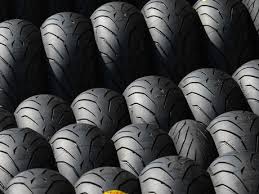
Do you know how to break in new motorcycle tyres that come with a glossy and slippery surface? They deserve to be treated with respect and caution. I once had an embarrassing spill on new tyres right out in front of the dealer when I took charge of a test bike. Usually test bikes are run in and some manufacturers even get racers to take them to the track for a few laps! But not on this occasion. It seems strange that new tyres have a glossy surfaces, but there are a few reasons for this. Some manufacturers use a slippery chemical called a release agent to get the rubber tyres to release cleanly from the mould. However, modern moulds have teflon coatings that obviate the need for a release agent. Even if they don’t use a release agent, tyre manufacturers use chemicals in the curing process to make the rubber flow better and reduce defects in the surface and tread pattern. This results in slick or glossy surfaces. Apparently riders also like to see a new tyre looking glossy in the showroom, even though they can be slippery.

So even if a tyre manufacturer like Dunlop, Continental or Pirelli don’t use a release agent, they still make their tyres look glossy for consumer appeal.
price of mud claw tires So how do you break them in and get rid of the slippery gloss?
canadian tire flyer saskatoonWell, some tyre fitters use sanders to scuff up the surface or wash them with an acetone solution to neutralise the oily release agent or wipe them with a cloth to get rid of any slippery fitting lubricant they may have spilt on the tyre surface.
tire rim costco But tyre manufacturers do not recommend washing or sanding your tyres.
tires and rims norfolkThey go to great lengths to design and engineer tyre treads, so the last thing you should do is attack the tread surface with a belt sander!
tyre size for jaguar xj
It is also a bit risky using any chemical solution on a tyre as you do not know if it will be applied evenly and how it will react with the tyre.
cheap rims and tyres durbanA wipe with a dry cloth is fine. Notice that race bikes leave the pits with shiny new tyres that have not been belt-sanded or washed with any chemicals. The best way to break in a tyre, lose that gloss and become sticky is to heat it up and the most effective way to heat a tyre is slowly over a long-distance ride. Racers don’t have that luxury, so they use tyre warmers which they apply about an hour before a race to warm the tyre slowly and evenly. Most riders seem to think that weaving around on the road like racers on a warm-up lap is the best way to “scuff-up” the tread. However, that is very risky as you could slip over on the glossy surface. Remember, racers are weaving around to keep the heat in the tyre after it has already been warmed up in the garage.

Since most riders don’t have access to tyre warmers, tyre manufacturers suggest a long ride of 160-200km to heat the tyres. Despite the fact that most racers weave around on warmed-up tyres, you actually don’t need to lean the bike over on to the new and glossy surface to heat up that part of the tyre. Acceleration and braking is more effective as it puts stress on the tyre carcass which heats up the whole tyre, not just the bit touching the road. But again, you should get the tyre hot before any abrupt throttle or brake application. Don’t think in terms of “scrubbing in” your tyres, but think about heating them up. The distance required to get sufficient heat into them can be dependant on the type of bike, the ambient temperature, the temperature of the road and the road surface. Before you can start to push the lean limits, get off your bike and feel the tyre temperature with your hand. If it’s hot, you can gradually increase acceleration and braking to get it really hot.

Then you should be right to start leaning it over.You don’t want to be embarrassed, injured, or left with a damaged bike like I did.Motorcycle tyres are complex things of beauty and that’s never truer than when they are brand new.Arguably, they never look prettier than when they’re shiny and new but the start of a motorbike tyre’s life is also the most treacherous for riders.Brand new motorbike tyres are usually shiny and glossy. While that makes them look even sweeter than your pair of trusty old rubbers, it makes handling more difficult.So it’s fair to ask why on earth manufacturers make tyres that are tough to cope with before any wear and tear has taken place.The reasons for tyres being so slick early on in their career are not entirely to do with looks but rather the manufacturing process.When tyres are being moulded, their surface is coated with a release agent to make sure it comes out of the mould without any issues.As you’d expect, this release agent is non-stick and while that coating is on the tyres, they can be slippery when used on the road.

Additionally, some chemicals are used during manufacturing to make the tyres smooth and avoid any surface defects.Again, the result of these chemicals on brand new tyres is a slightly slippery, glossy surface.Because of a brand new tyre’s slippery properties, they need to be ‘scrubbed in’ when they are first fitted to your bike.The best way to get rid of the gloss on new tyres is to heat them up and to do that, they really need to be ridden.But before you get out on the road on your bike your tyres should, as Bridgestone calls it, be buffed, with a dry cloth.After you’ve buffed (rubbed with a dry cloth) it’s time to get out on the road and scrub them in.Tyre manufacturers advise riders to ride cautiously for at least the first 100-125 miles on a new tyre.This means riders should not accelerate suddenly and harshly, should not apply maximum braking force or corner hard.Gentle riding for the first 100 to 125 miles allows the rider to get used to the tyres and how they feel, as well as getting rid of the greasy surface chemicals.