boat trailer tires seattle

SHOP ALL SPRING BLACK FRIDAY DEALS + FREE SHIPPING ON QUALIFYING ORDERS $49 OR MORE Prices, promotions, styles, and availability may vary. Our local stores do not honor online pricing. Prices and availability of products and services are subject to change without notice. Errors will be corrected where discovered, and Lowe's reserves the right to revoke any stated offer and to correct any errors, inaccuracies or omissions including after an order has been submitted.This e-store offers geniune replacement parts for EZ Loader Custom Boat Trailers. Each Custom Trailer is built specifically for your boat and to ensure you receive the correct parts we will need your VIN number from your trailer or paperwork. The VIN number for these trailers begins with 1L8 or 1DH. If your VIN number begins with 1ZE, these parts are available at EZ Loader Adjustable Parts Store. Please verify your VIN number before ordering parts as most custom parts are not compatible with adjustable parts. If a particular trailer part or trailer accessory is not listed on this site, or you just have a question, contact the EZ Loader Boat Trailer Parts Department at (800) 553-7855 x254 or at Custom Parts

WELCOME TO EZ LOADER Since 1953, EZ Loader Boat Trailers has been the leader in manufacturing boat trailers with over ten patents and millions of dollars in trailers sold nationally and internationally each year. With three manufacturing facilities and fourteen distribution centers in North America, and twenty four worldwide, EZ Loader is truly 'How the World Gets to the Water'.
light truck tire recapsEZ Loader is the one stop shop for any type of recreational boat trailers.
second hand tires edmontonWe specialize in making trailers for every boat, every budget, and every body of water.
used tires for sale in petaluma caBuy EZ Loader roller or bunk style trailers. Choose from galvanized, powder-coated, aluminum, wet-painted systems and "Tuff Coated" Polyurea coatings.
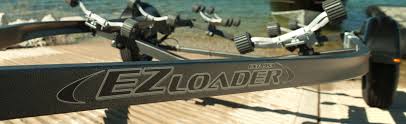
And trust trailers that carry from 600 pound capacity to 15,000 pound capacity. No other company sells, services and is better known or more well-respected around the globe than EZ Loader. LEARN MORE ABOUT EZKawasaki Jetski / Wave Runner STX 1100 And 750 + Trailer = Excellent Health (Fits: More than one vehicle) C. E. Smith Company, Inc. was established as a manufacturing firm producing precision metal stampings, fabrications and assemblies for a broad variety of industries. We are committed to providing precision stampings, innovative products and excellent service to both manufacturing and aftermarket accounts. The entire team in our 85,000 sq. ft. manufacturing facility and our 60,000 sq. ft. distribution center is dedicated to providing the high quality products and the efficient, responsive service our customers deserve. Under the SMITHTM trademark, C. E. Smith Company, Inc. manufactures and sells replacement parts for small to mid-size boat trailers including trailer fenders, boat guides, galvanized bracketry, tire carriers, replacement wheel bearings, rubber rollers, roller shafts, u-bolts and other requirements for boat trailers.

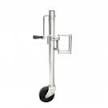
Each year we challenge ourselves to a higher level. Introducing new and better products to give our customers a full-line source and the best value in trailer parts and accessories. A variety of parts are stocked and sold to marine distributors and retailers, while many others are custom made specifically to a trailer builder's specifications. Thanks to the confidence of our customers, we have grown to be a recognized name in the marine industry. Stainless steel boating and fishing products includes an adjustable, completely stainless steel t-top, fiberglass electronic boxes, t-top storage bags navigation lights and antenna bracket. The line of stainless steel rod holders includes 2 way clamp models, adjustable clamp models, outrigger and flush mount models.Working with our offices in Taiwan and China, we are able to source unique items for our product line, in addition to providing direct import and private label packaging for both O.E.M. and after market customers. 1000 lb. Capacity Swing-Back Trailer Jack

1500 lb. Capacity Dual Wheel Swing-Back Boat Trailer Jack 2000 lb. Capacity Drop Leg A-Frame Trailer Jack 3500 lb. Capacity Drop Leg Heavy Duty Electric Trailer Jack 2000 lb. Capacity Drop Leg Trailer Jack 3500 lb. Capacity Drop Leg Heavy Duty Trailer Jack 2000 lb. Capacity Swing-Back Trailer JackBy Ted Sensenbrenner and Dustin HooverQ: I have a trailer with 12-inch wheels. If I install 15-inch wheels, do you think the trailer will float? Ted: This might seem like a silly question to some, but I've seen it happen. I once delivered a boat on an aluminum trailer with aluminum wheels and it floated once the boat was off-loaded. The real trick was getting the boat back on the trailer when trying to retrieve it. At issue is this: will larger tires with a higher PSI, make the entire trailer float? Dustin and I agree that you're probably not going to have any trouble with a too-buoyant trailer so long as it's made of galvanized steel. If your trailer is aluminum, the situation changes because aluminum is so much lighter and that's when you might be facing a floating trailer.
One more thing that is going to help if the trailer is bunk: Use cypress wood because it's denser which means it's heavier than the usual pine used to build bunks. If you have a roller trailer, this is a good time to make sure you have galvanized brackets. But you've got one more concern, and this is important: Will the larger tires hit the fenders? If so, then that's a bigger problem because the trailer isn't going to be able to move. Let us know how this goes.Q: I have a dual-axle trailer with surge drum brakes on the front axle only. The left brake locks up regularly either after having the trailer parked for a while (backed uphill) or when applying the brakes going down the road. It doesn't happen on the right side. I've removed the drum to verify proper lubrication; I've adjusted the brake shoes both looser and tighter; I've bled the brake lines and had a shop bleed the brake lines. The trailer is essentially new, 2010, and typically only driven a few miles to the water, although I've taken it to Maryland and back to Vermont twice.
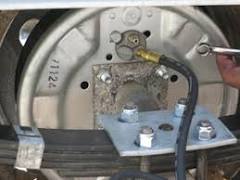
Dustin: The brake wheel cylinder could be hanging up, causing the wheel to lock. This happens a lot with drum brakes and it's not always obvious why they do it. We've had to take many, many brakes off trailers and replace them and the drum because we just couldn't find a distinct problem. Proper lubrication is a good first step. While you're in there, carefully inspect the return springs and where the shoe and backing meet, and ensure it's properly lubed and free of corrosion. If that doesn't change anything, it's easiest to replace the cylinder instead of wasting time trying to find the missing link, or should I say "kink."Q: My brake line has a 3,000-psi pressure rating. I noticed there are brake lines that use only 1,200 psi. Is this because of the difference between drum and disc brakes? Ted: Most brake lines will handle the psi load of both drum or disc brakes. Disc brakes do have a higher psi because they activate stronger and harder. It never hurts to go heavy on an item such as a brake line.

Generally speaking, lighter trailers tend to use drum brakes and use lighter brake lines. The physics of drum brakes is such that there's a levered force at work, which delivers better braking torque at a lower hydraulic pressure. Disc brakes require higher static-line pressure for effective braking. You often see trailers lighter than 3,000 pounds GVW (gross vehicle weight) with drum brakes, which are cheaper and more effective. For trailers over 3,000 pounds, braking performance is comparable with both drum and disc brakes. I prefer disc brakes as they tend to have better performance when driving in the rain because the water is flung from the braking surface, whereas water can pool slightly in the drums on drum brakes.Q I'm pulling 3,500 pounds with a 2-inch hitch ball. I've seen other 2-inch hitch balls that can carry 5,000 pounds. Do I gain anything by getting a heavier one even if my boat and trailer weigh 3,500 pounds fully loaded? Dustin: You're not going to gain much by going to a larger-rated ball other than peace of mind.

The larger rating is probably because the ball has a larger shank with which to bolt it on.Ted: A 2-inch hitch ball is usually affixed to a Class III or Class IV hitch and has a 1-inch shank diameter. If your 2-inch ball is affixed to your bumper, it makes no sense to increase the hitch-ball capacity because your bumper can't handle a capacity of 5,000 pounds. If you're using a standard Class III or Class IV hitch, the beefier the better. A 2-inch ball can go up to 8,000-pounds capacity and even greater. But over 8,000 pounds, I'd consider using a 2 5/16-inch hitch ball. Trailer hitch balls are sold in various shank lengths and diameters, ball diameters, and weight capacities to meet your towing needs. It sounds like what you have now fits the bill, so I wouldn't change anything.Q OK, I'm at a loss. When I use my turn signals, the one I want to signal does fine but the other side is also flashing. This happens only with the left signal. I'm glad I only have to go to the boat ramp during daylight hours but this is bugging me.

Ted: This is most likely caused by a loose or bad ground. The light is trying to steal a ground in order to work. So, I'd check all the grounds and connections on the entire trailer. I sometimes find that odd light behavior is a result of corrosion. Your right lamp shouldn't be getting any signal to flash when indicating a left turn. Is this only happening when you're using the left turn signal and braking at the same time? If yes, I suspect corrosion and I'd attempt to clean the inside of the fixtures or replace them. Another way to troubleshoot is to get a handy little test light and start at the vehicle connections or vehicle trailer light converter and work backward toward the lamps. The left signal should only use the yellow wire and the right signal should only use the green wire. The yellow and the green wires should not be touching unless they're sheathed. If there's a bare part of either wire and they're touching somewhere, such as where the connections are made, that could very well be the problem.
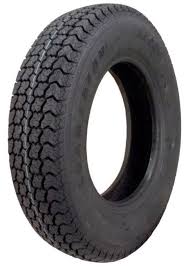
Q I have to replace one trailer tire on my single-axle trailer. The guy at the tire store is saying I should replace both tires at once. Is he trying to sell me something I don't need? The other tire looks fine to me. It's not the money. I just don't want to be taken advantage of. Dustin: I haven't heard of having to replace both tires at the same time. However, if you do replace both, you can keep better records on how old they are and how many miles you've put on the set. For that reason alone, it's not a bad idea to replace them both at the same time. So, bottom line: if one needs replacement, replace them both so you're not kicking the good one when you find yourself on the side of the road.Q If I'm replacing a spindle, does it make sense to also replace the axle? How do I know if it needs to be done? Ted: Not to discourage you, but unless you have bolt-on spindles, replacing them usually involves breaking the weld to the axle and welding on a new one. It must be aligned perfectly or you're asking for trouble down the road.

An experienced welding shop can do this. You'll save some money by removing the axle yourself and having it welded, but a whole new axle with two new spindles won't cost you that much more. If you see any signs of pitting on the surface of the axle, or the area that the bearing rests against is thin and worn, then replace the axle, complete with spindles. There are only a few manufacturers that offer a removable spindle on a torsion-axle assembly. Dustin and I agree that it's fine to cut the spindle off and weld a new one on, but you take the chance of burning up tires because of misalignment. We vote to replace the whole axle. Then you have a better chance of proper alignment because the whole axle was built in a factory with alignment controls in place.Q I keep losing the bearing protector on the right side of my trailer. I've replaced three of them already this year and it seems to happen after 30 minutes of interstate driving. Dustin: I'd check the bearings, tires, and suspension to see if there's something causing a vibration.

Most of the time, the caps come off because of vibration or heat buildup from bad bearings. I don't personally use Bearing Buddies on my trailer for putting grease into the hubs, but I do use them on my trailer because they're a thicker metal that seems to hold better to the hub once installed. The other trick is to put silicone on the edge of the cap when installing them. Do yourself a favor and give the wheel assembly a shake and spin to be sure all's well. I suspect if you inspect it carefully, or better yet, clean and repack the bearings, you'll have the problem solved.Q My buddy and I have the same boat but his engine is a four stroke (heavier) and I've got a two stroke (lighter) outboard. We were looking at each other's trailers the other day and I noticed his leaf springs have 5 leaves and I've got 7. They're different trailers but why would there be a difference in the number? Ted: The boat may be the same, but the engine, trailer, axle and springs are not which is going to make it tough to give you a good answer.